Steel That Holds the Schedule: How Structural Steel Strategy Drives Speed and Certainty in Complex Builds
In complex construction, structural steel is a schedule decision before it is a material decision. Its value comes from what it makes possible: off-site fabrication while site work advances, faster erection once delivered, longer spans, high-bay flexibility, and earlier access for the trades that follow.
This blog breaks down how owners and developers should think about steel versus concrete, fabrication lead times, early procurement, erection sequencing, and structural coordination in industrial, warehouse, manufacturing, and commercial projects.
The takeaway: schedule certainty is built before steel reaches the site. It depends on early structural strategy, coordinated design, controlled release packages, and one accountable delivery approach from planning through erection.
Why does structural steel strategy decide a project’s schedule?
Structural strategy decides the schedule because the framing system is the first major commitment on a project, and every trade that follows is paced by it. By the time the structure is going up, the decisions that govern speed have already been made, in design, in procurement, and in how the structural scope was planned.
This is the part owners often underestimate. A framing choice is treated as a structural-engineering question, when it is just as much a schedule and risk question. The right structural strategy can compress the timeline and reduce uncertainty. The wrong one, or the right one executed late, introduces delay that no amount of effort recovers later in the build.
For developers and owners on complex projects, especially those with firm delivery dates, this reframes structural steel from a line item into a schedule strategy. The rest of this article covers how that strategy works and where it matters most.
What does “schedule certainty” mean in construction?
Schedule certainty is the confidence that a project will reach its milestones and completion date as planned, rather than slipping. It comes from controlling the activities on the critical path, including structural design, fabrication, and erection, so that delays are prevented before they occur rather than absorbed after the fact.
Steel or concrete: which framing system fits your project?
The right framing system depends on the building’s geometry, schedule, and use, and steel and concrete each win in different conditions. Neither is universally better. The decision should be made on the specific demands of the project, ideally early enough to shape the design.
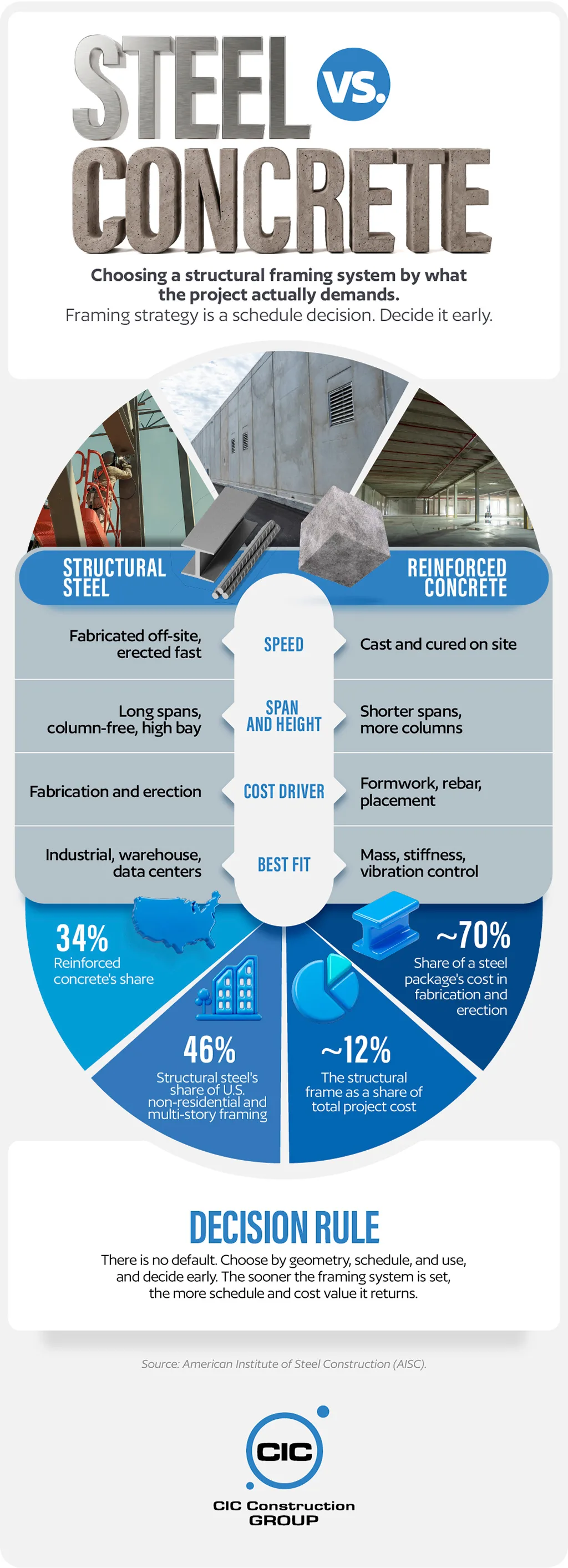
Structural steel tends to lead on speed, long spans, and clear height. Because steel members are fabricated off-site in a controlled shop while site and foundation work continue, the structure can be erected quickly once it arrives, which is a direct schedule advantage on time-sensitive builds. The American Institute of Steel Construction reports that structural steel has been the most widely used framing material for U.S. non-residential and multi-story buildings, at roughly a 46% market share, compared with about 34% for reinforced concrete, a preference driven in large part by speed and span. Cast-in-place concrete, by contrast, can be the better fit where mass, stiffness, vibration control, or specific fire and acoustic conditions govern, and where site casting suits the geometry.
The practical point is that this is a trade-off to evaluate deliberately, not a default to inherit. The earlier the framing decision is examined against the project’s real constraints, the more schedule and cost value it returns.
Is structural steel faster than concrete?
Often, yes, because steel is fabricated off-site in parallel with foundation and site work, then erected quickly once delivered. Concrete framing is typically cast and cured on site, which can extend the structural timeline. The advantage depends on the building type, but for many industrial, warehouse, and commercial projects, steel’s off-site fabrication is a meaningful schedule benefit.
Why do steel fabrication lead times make early decisions so important?
Fabrication lead times make early decisions critical because the structural frame must be detailed, ordered, and fabricated long before it can be erected, and that work cannot be compressed at the end. The steel package is a scheduled chain of activities, and the schedule starts the day the design is released to the fabricator, not the day steel arrives on site.
The cost structure explains why this matters so much. AISC notes that around 70% of the cost of a steel package comes from fabrication and erection, and that bringing a fabricator on board early can pay off significantly. Early involvement lets the team coordinate connections, sequencing, and detailing while changes are still inexpensive, rather than discovering conflicts after fabrication has begun. The same source notes that material is a smaller lever than owners assume: the frame is around 12% of total project cost, and a 5% change in steel price represents less than one-fifth of one percent of total project cost. In other words, the schedule and coordination gains from early planning matter far more to the budget than the price of the steel itself.
This is the strongest argument for early contractor involvement on any steel-framed project. The decisions that protect the schedule are made during design, and they depend on the fabricator and builder being at the table before the structural package is locked.
Why should a steel fabricator be involved early in design?
Because most of a steel package’s cost and schedule risk lives in fabrication and erection, not material. Engaging the fabricator during design allows connections, detailing, and erection sequencing to be coordinated while changes are still cheap, which AISC notes can deliver significant savings. Early involvement prevents the conflicts and rework that surface when steel is detailed in isolation.
How does erection sequencing affect the critical path?
Erection sequencing affects the critical path because the order in which steel is raised determines when the building can be enclosed and when every following trade can begin. Sequencing is not a field detail decided on site. It is a schedule driver that should be planned with the design.
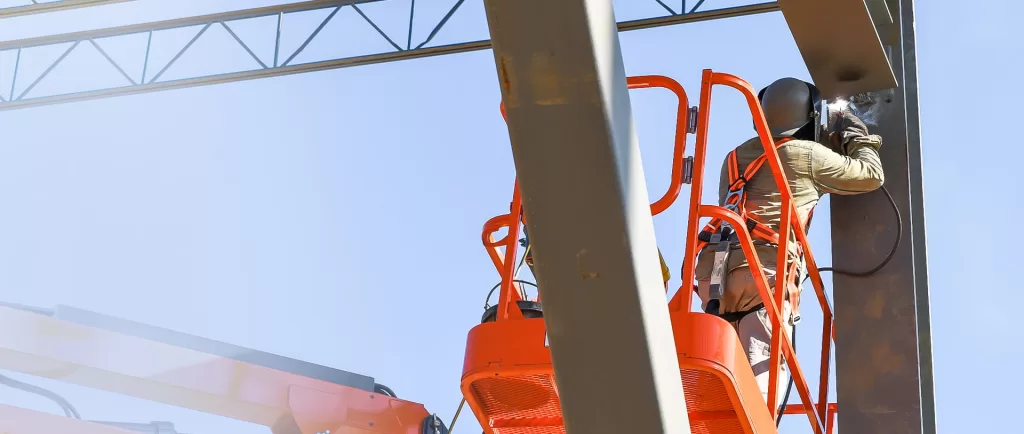
A steel frame goes up in a deliberate order, and that order ripples through the entire project. The sequence governs when the roof and envelope can close, when mechanical and electrical work can start overhead, and when interior trades can follow. A well-planned sequence keeps those handoffs flowing. A poorly coordinated one stalls trades that are otherwise ready to work, and that lost time usually cannot be recovered.
Because erection sits on the critical path, it rewards planning that connects detailing, delivery, and field operations into one sequence. When the steel arrives in the order it will be erected, and the erection plan matches the design intent, the structure becomes an accelerator rather than a bottleneck.
Where do steel’s long-span and high-bay advantages matter most?
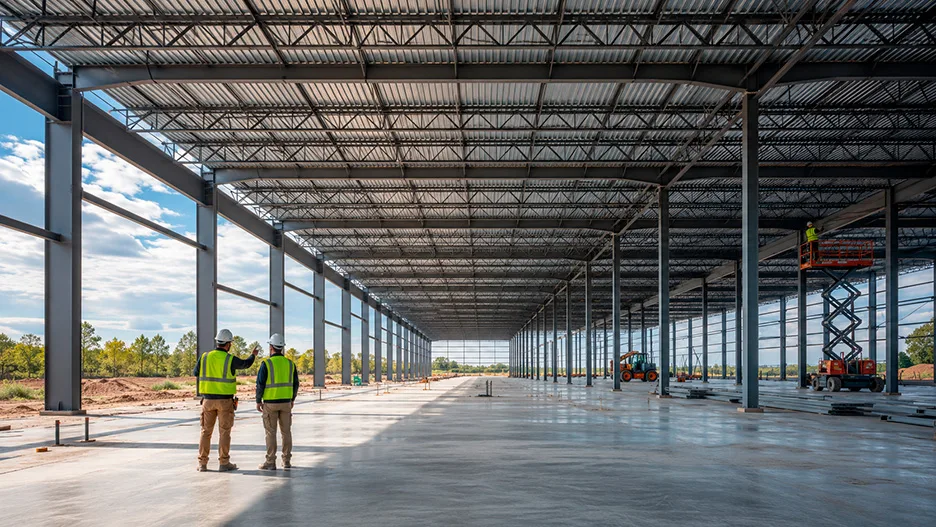
Steel’s long-span and high-bay advantages matter most in industrial, warehouse, and manufacturing buildings, where column-free space and clear height are functional requirements, not preferences. These are the building types where steel’s structural geometry translates most directly into operational value.
Long spans let a building carry wide, open floor plates with fewer columns, which is exactly what distribution centers, manufacturing floors, and high-bay warehouses need to move goods, run production lines, and reconfigure layouts over time. Clear height supports racking, equipment, and material handling. Steel achieves these efficiently, which is one reason it dominates these sectors. That alignment is especially relevant now: AISC’s market reporting describes data centers and manufacturing plants as the projects carrying non-residential construction into 2026, the same large, schedule-driven, long-span buildings where structural steel strategy delivers the most.
For markets seeing industrial and manufacturing growth, including nearshoring-driven facilities, this is the practical intersection of structure and business. The framing system that builds these facilities fastest, with the spans they require, is usually steel.
Why is structural steel used for warehouses and manufacturing facilities?
Because these buildings need long spans, column-free floor space, and clear height, and steel provides them efficiently. Wide spans support open layouts and flexible reconfiguration, while steel’s off-site fabrication speeds the schedule on the large footprints these facilities require. That combination of span, height, and speed is why steel is common in industrial, warehouse, and manufacturing construction.
How does controlling the structural scope reduce delays?
Controlling the structural scope reduces delays because most structural delay is born in the handoffs between design, fabrication, and erection, and fewer handoffs mean fewer gaps. When detailing, procurement, fabrication, and field erection are coordinated under one point of accountability, the interfaces that usually cause problems are managed rather than negotiated across separate parties.
The risk in a fragmented structural scope is that each handoff is a place for information to be lost or misaligned. A detail that does not match the erection plan, steel that arrives out of sequence, or a connection conflict discovered in the field all become schedule problems, and when responsibility is split, they also become disputes. Tight coordination of the structural scope closes those interfaces before they reach the field.
This is the practical case for integrated delivery on complex builds. When the structural frame is planned and controlled as one connected effort, the schedule it drives is far more predictable, and accountability for that schedule sits in a single place.
What causes structural steel delays on a project?
Most are caused by coordination gaps between design, detailing, fabrication, and erection rather than by the steel itself. Late design release, details that do not match the erection sequence, out-of-sequence delivery, and connection conflicts found in the field are common triggers. Coordinating the structural scope under single accountability prevents these handoff failures.
What should owners look for in a structural steel partner?
Owners should look for a partner who treats structural steel as a schedule strategy, with the coordination strength to control detailing, fabrication, and erection as one connected effort. The goal is to find a builder who manages the structural scope proactively, not one who reacts to it in the field.
A few questions surface the difference. Does the partner engage early enough to influence the framing decision and the structural design, when those choices still carry the most schedule value? Can they coordinate detailing, fabrication, and erection sequencing so the steel arrives and goes up in the right order? Do they understand how the structural frame paces the envelope and every following trade? And can they hold accountability for the structural schedule in one place, rather than spreading it across parties who can point fingers when something slips?
Partners who answer these well share a trait: they control the structural scope tightly and coordinate it with the rest of the build. That integration is what turns the structure into a schedule advantage instead of a risk, which is the entire point of a sound structural steel strategy.
How can an owner reduce structural schedule risk?
Engage the builder and fabricator early, during design, so the framing decision and detailing can be optimized for schedule. Confirm the partner can coordinate fabrication and erection sequencing as one effort and hold accountability for the structural schedule in a single place. Early involvement and integrated control of the structural scope are the most reliable ways to protect the timeline.
How CIC Construction Group approaches structural steel
CIC Construction Group treats structural steel as part of an integrated build, coordinated with concrete, civil, and the rest of the structural scope rather than handled as an isolated trade. The advantage of that approach is schedule certainty. When the structural scope is planned and controlled together, the handoffs between detailing, fabrication, and erection that usually create delay are managed in one place, under single accountability.
Across the industrial, manufacturing, life sciences, and commercial projects CIC delivers in Puerto Rico, North Carolina, and Florida, that integration is what keeps the structural frame, and the schedule that depends on it, on track. The same discipline that governs the concrete and civil scope carries through the steel, so the structure becomes an accelerator rather than a risk.
For owners weighing a complex build, the structural partner’s ability to control that scope is not a minor detail. It is often the difference between a schedule that holds and one that slips. Where the structural strategy is sound and the execution is coordinated, the steel does more than carry the building. It carries the schedule.
Frequently Asked Questions
Is steel always the right framing choice for a complex build?
No. Steel leads on speed, long spans, and clear height, which suits many industrial, warehouse, and commercial projects, but concrete can be the better fit where mass, stiffness, vibration control, or specific fire and acoustic conditions govern. The right choice depends on the building’s geometry, use, and schedule, and is best evaluated early in design.
How much of a steel package’s cost is material?
Less than most owners expect. AISC reports that around 70% of a steel package’s cost comes from fabrication and erection, and that the frame is roughly 12% of total project cost. A 5% change in steel price moves total project cost by less than one-fifth of one percent, which is why schedule and design decisions matter more than material price.
What is the biggest schedule risk with structural steel?
Coordination gaps between design, fabrication, and erection. Late design release, detailing that does not match the erection sequence, and out-of-sequence delivery are common causes of delay. Because erection sits on the critical path, these handoff failures stall the trades that follow, which is why integrated control of the structural scope matters.