Built on Solid Ground: Why Concrete and Structural Excellence Determine Long-Term Project Success
In construction, some decisions stay visible: the facade, the finishes, the lobby, the first impression. Others disappear into the building the moment they are completed. Concrete is one of them.
Once a foundation, slab, structural frame, or elevated deck is placed, it becomes part of the building’s permanent logic. It determines load paths, floor elevations, column spacing, tolerance, adaptability, and how the structure will perform under daily use for decades. That is why concrete and structural work should never be treated as commodity scope. It is one of the earliest and most consequential forms of risk management on any project.
A poor finish can be corrected. A delayed fixture can be replaced. A structural mistake can hide for months before showing up as cracking, moisture infiltration, differential settlement, floor flatness issues, or durability problems. By then, the fix is an intervention into a system that was meant to remain stable.
For owners, developers, architects, and project teams, the lesson is direct: the quality of the concrete and structural execution accepted early in the project will shape the performance, resilience, and operating cost of the asset long after construction is complete.
Concrete Is Where Project Performance Becomes Permanent
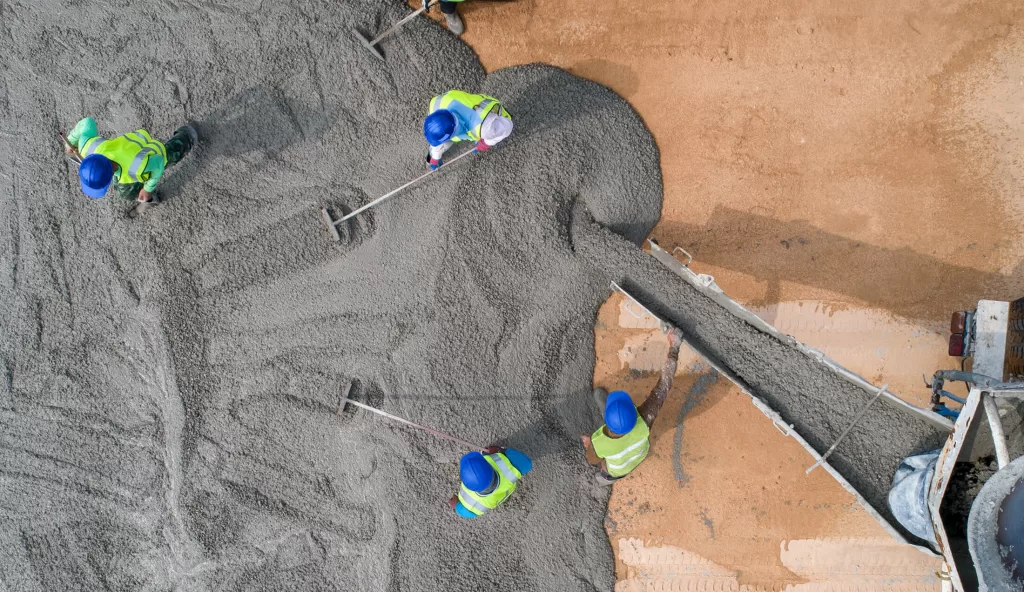
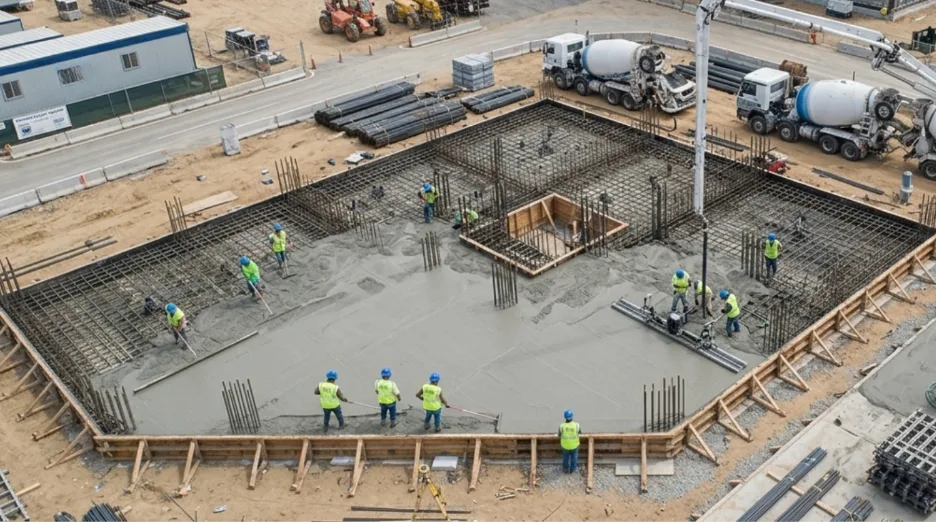
Concrete occupies a unique position in the construction sequence. It is both an early milestone and a long-term commitment. The work performed during site layout, forming, rebar placement, placing, finishing, and curing sets the physical conditions for everything that follows.
That permanence creates asymmetric risk. Electrical rough-in errors may cost hours or days to correct. A concrete placement that misses strength, tolerance, or curing requirements can affect schedule, budget, operations, and asset value.
This is where contractor capability matters. CIC’s concrete services emphasize experienced crews, structural concrete work, rebar placement, forming, placing, finishing, and equipment support that provide control over schedule, cost, and quality. In structural work, that control is a performance requirement.
In 2026, Concrete Is More Engineered and Less Forgiving
The construction market is changing. Concrete is no longer a default material ordered by volume and judged only at the pour. It is an engineered system shaped by cement chemistry, aggregates, admixtures, reinforcement strategy, environmental exposure, placement method, curing discipline, and testing protocols.
One major shift is the wider use of portland-limestone cement, also known as Type IL. According to PCA/GCCA reporting based on U.S. Geological Survey data, blended cements reached 54.5% market share in June, and portland-limestone cement represented 95% of blended cement, marking the first time it represented more than 51% of the U.S. portland and blended cement market.
The sustainability pressure behind this shift is real. The World Economic Forum notes that global cement manufacturing is responsible for about 8% of total CO2 emissions. For owners, this does not mean choosing sustainability over performance. It means choosing teams that understand how to deliver both: lower-carbon material strategies, verified structural performance, and long-term durability.
The best concrete strategy in 2026 is not “stronger concrete.” It is the right concrete system for the project’s use, exposure, schedule, tolerance, and lifecycle requirements.
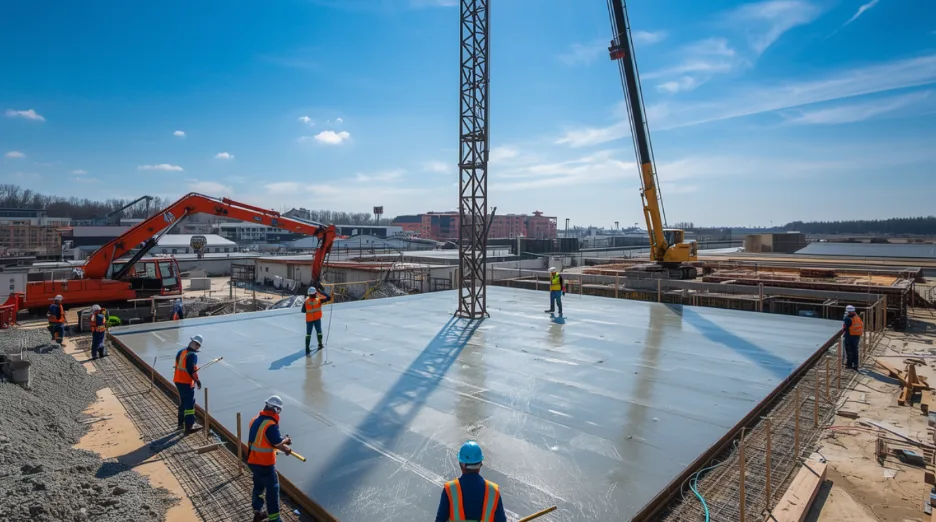
Where Structural Excellence Matters Most
Structural excellence becomes especially critical when the building’s performance depends on tight tolerances, demanding loads, harsh exposure, or future adaptability.
Industrial and logistics facilities are a clear example. A slab in a warehouse or manufacturing environment is not just a floor, is an operating platform. Automated storage systems, forklifts, racks, heavy equipment, and repetitive wheel loads can expose small tolerance failures quickly. ASTM E1155 provides a quantitative method for measuring FF floor flatness and FL floor levelness numbers, which is why owners should define floor performance early, not after operations begin.
Core and shell projects create a different challenge. The base building must support uses that may evolve over time. Column grids, floor loading, floor-to-floor heights, structural penetrations, and future mechanical/electrical/plumbing (MEP) coordination all affect lease flexibility and tenant improvement efficiency. A well-executed shell does more than stand up. It preserves optionality.
Parking structures and elevated decks often require another level of precision. The Post-Tensioning Institute describes post-tensioned concrete as a light, structurally efficient, durable solution that can provide longer spans, thinner members, lower building heights, and better crack control when properly designed and executed.
Coastal and hurricane-prone markets add another layer. According to NASA’s sea level data resource citing United Nations data, 40% of the world’s population lives within 100 kilometers of a coast. In Puerto Rico, North Carolina, Florida, and other coastal markets, salt exposure, moisture, wind-driven rain, and corrosion risk must be addressed through material selection, cover depth, detailing, quality control, and execution discipline.
Advanced Concrete Systems Are Tools, Not Buzzwords
The value of advanced concrete systems depends on knowing when to use them and how to execute them. High-performance concrete, post-tensioned slabs, self-consolidating concrete, fiber reinforcement, and ultra-high-performance concrete all have legitimate applications, but none of them compensate for weak planning or poor field control.
High-performance concrete can support demanding strength, durability, and permeability requirements. Post-tensioned concrete can help reduce structural depth, manage deflection, improve crack control, and open more flexible spans. Self-consolidating concrete can improve placement in congested reinforcement areas or complex forms. Fiber reinforcement can support crack control and impact resistance in selected slab applications.
Ultra-high-performance concrete is more specialized. The American Concrete Institute’s UHPC report defines UHPC as a material with greater strength, tensile ductility, and durability properties than conventional or high-performance concrete, with a minimum specified compressive strength of 22,000 psi and very low permeability.
For owners, the question should not be “What is the strongest system available?” Is: “Which structural system aligns with the building’s risk profile, intended use, construction schedule, lifecycle cost, and future adaptability?”
Quality Control Is Where Performance Gets Proven
Specifications do not create quality by themselves. They define the target. Performance is achieved through planning, coordination, field execution, testing, inspection, and curing discipline.
Quality control begins before the first truck arrives. Mix designs should be reviewed against project requirements, exposure conditions, placement constraints, finishing expectations, and schedule milestones. For specialized systems, mockups, pre-placement meetings, and sequencing reviews can be the difference between controlled execution and reactive troubleshooting.
Testing also matters. The American Concrete Institute explains that specified compressive strength is generally based on 28-day test results unless the construction documents state otherwise, while 3-day or 7-day results are typically used to monitor early strength gain. That distinction is important when early loading, formwork removal, or post-tensioning schedules depend on reliable strength development.
Curing is just as critical. Concrete does not simply dry; it hydrates and gains properties through a chemical process that depends on moisture and temperature conditions. The ACI Guide to External Curing of Concrete focuses on practices, procedures, materials, and methods for curing because inadequate curing can compromise surface quality, strength development, durability, and long-term performance.
Floor tolerance verification, cylinder testing, inspection reports, and curing documentation should not be treated as paperwork. They are evidence that the structure being built is the structure that was designed.
Structural Execution Is a Contractor Capability Issue
Owners often compare contractors by price, schedule, and portfolio. Those factors matter, but structural work requires a deeper question: who has the field capability, supervision, and accountability to control the most permanent parts of the project?
Any contractor can source a concrete mix. Fewer can coordinate the mix design, reinforcement, formwork, placement sequence, quality control, curing, testing, embedded conditions, MEP penetrations, structural steel interface, and critical path schedule with the discipline complex projects require.
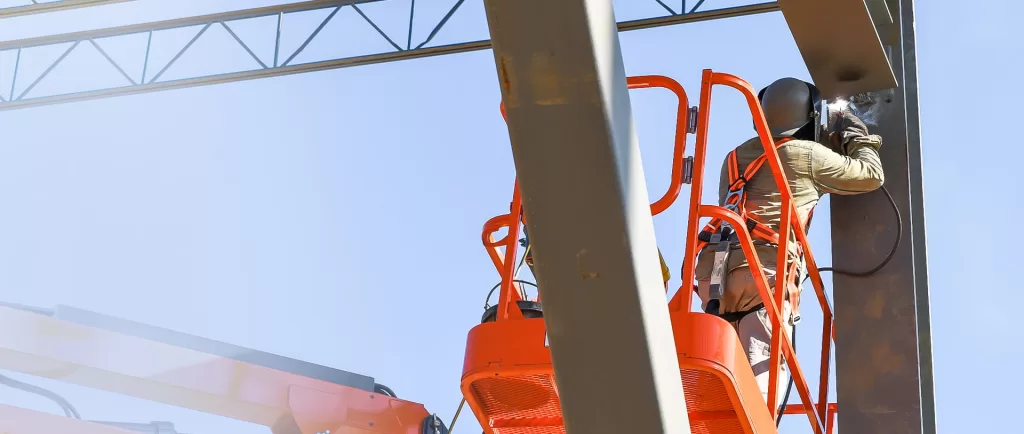
This is especially important when concrete and steel are interdependent. CIC’s structural steel team works with designers and construction teams to deliver custom structural steel solutions, while the company’s broader model includes pre-construction, general contracting, design-build, concrete, architectural interiors, structural steel, and construction equipment.
That same principle connects to cost control. CIC’s pre-construction planning perspective emphasizes accurate cost projections, advanced estimating tools, and market data; its budget management approach reinforces that realistic budgets begin before construction starts. In structural work, early cost planning is how teams avoid late redesign, missed tolerances, procurement surprises, and rework.
The Lifecycle View: Durability, Adaptability, and Total Cost
The cheapest structural decision on bid day is not always the lowest-cost decision over the life of the asset. A slab that performs for decades, a structural grid that supports multiple tenant configurations, or a parking deck that resists cracking and corrosion can create value long after the original construction budget is closed.
Lifecycle thinking is also tied to sustainability. Because cement production carries a significant carbon footprint, reducing waste, avoiding rework, extending service life, and selecting efficient structural systems can all support better environmental outcomes.
This is where expertise becomes visible, even when the concrete itself is hidden. Strong structural planning can improve constructability, protect schedule, reduce operational disruptions, and preserve building value. Weak structural planning can turn the building’s most permanent system into its most expensive liability.
Build the Project on What Cannot Be Replaced
Concrete and structural systems are the foundation of every operational promise the building must keep: safety, durability, adaptability, schedule certainty, and long-term performance.
When owners evaluate a contractor for a complex project, the conversation should focus on who understands the structural risk profile, who can coordinate the work before it reaches the field, who can verify performance through quality control, and who will remain accountable when the building begins its real life: operations.
For commercial, industrial, life sciences, healthcare, logistics, parking, core and shell, and coastal projects, structural excellence is not an upgrade. It is the ground everything else depends on.
Planning a project where structural performance cannot be left to chance? Connect with CIC Construction Group to discuss concrete, core & shell, structural steel, pre-construction, and integrated delivery strategies for your next build.