The Foundation of Success: How Strategic Pre-Construction Planning Reduces Project Problems, and Final Cost
Before the first shovel hits the ground, most project outcomes are already being decided, by how clearly the team defines scope, how early risks are surfaced, and how disciplined the plan is before procurement and fieldwork lock in the cost of change.
In 2026, that discipline matters more than ever. The construction industry is still operating under workforce constraints. Associated Builders and Contractors estimates the industry needs to attract 349,000 net new workers in 2026 to meet demand. And AGC’s workforce survey reports that about 92% of firms are having difficulty filling both craft and salaried positions.
When labor and availability are this tight, the margin for “we’ll figure it out in the field” is effectively gone.
The pre-construction phase is where feasibility becomes clarity, risk becomes a plan, and budgets become defensible.
Also read: Pre-Construction Planning, The Blueprint for Success
Why pre-construction is the cheapest risk mitigation you can buy
Owners don’t lose money because the plan was imperfect. They lose money because the team discovered constraints late, after procurement started, after the schedule was committed, or after the field built something that should have been resolved on paper.
Construction Industry Institute (CII) research points to a consistent pattern: effective front-end planning sets the stage for better cost performance, reduced schedules, fewer changes, better operational performance, and fewer “project disasters.”
That’s the core ROI: fewer surprises and earlier certainty.
Feasibility: the “reality check” before design gets expensive
Strategic feasibility work isn’t a box to check, it’s how you avoid designing a project that can’t be built within the real constraints of the site and approvals.
Site realities often diverge from assumptions. Geotechnical conditions may require foundation systems exceeding preliminary budgets. Utilities may occupy planned locations. Environmental constraints may limit methods or require expensive remediation. Zoning may prevent intended use or limit height.
Comprehensive analysis addresses these systematically: geotechnical investigation provides actual bearing capacity for reliable foundation costs, topographic surveys reveal drainage and earthwork challenges, utility mapping identifies relocation requirements, and environmental assessments quantify remediation before they become change orders.
Budget reality-checking validates cost assumptions before significant design investment. When estimates reveal gaps, owners can adjust scope or secure funding before incurring substantial design costs, rather than discovering feasibility issues during construction that force down-scoping or emergency funding.
High-value feasibility includes:
- Site and utility constraints: capacity, tie-in requirements, shutdown windows, constructible routes
- Regulatory and permitting pathway: what approvals are required, sequencing, and likely lead times
- Budget reality check: rough order of magnitude aligned to scope and local market conditions
- Risk flags: items that can become critical path (utility upgrades, long-lead equipment, phasing)
This phase is where good teams reduce the chance that the project drifts into redesign loops.
Scope definition and alignment, the most underused cost-control lever
Many project problems are scope problems in disguise: stakeholders not aligned on requirements, incomplete criteria, or decisions deferred until late design.
A practical way to improve alignment is using a scope-definition framework, like CII’s Project Definition Rating Index (PDRI) approach. CII describes PDRI as a tool that identifies critical elements in a scope package and helps teams identify risk factors tied to cost, schedule, and operating performance before design and construction are locked in.
NASA’s public implementation guidance describes PDRI as a “best practice” tool that helps quantify the completeness of scope definition and promotes alignment between owners and project teams early.
Owner takeaway: a tighter scope definition is not bureaucracy. It’s the foundation for fewer change-driven cost increases.
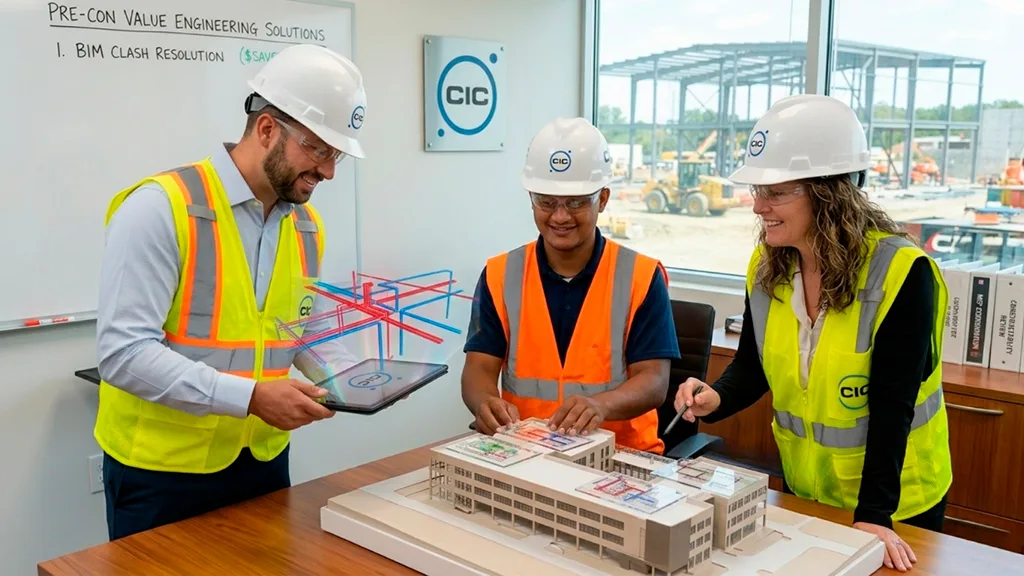
Constructability + BIM coordination, prevent RFIs and rework before they exist
Constructability review is where design becomes buildable, or reveals where it isn’t…
A modern pre-construction workflow typically includes:
- Early clash detection and coordination
- Installation sequencing constraints (clearances, access, laydown)
- Code and compliance checks with field reality
- “Design for procurement” decisions (long-lead packages, alternates)
If you’re also planning for safety and operational constraints, pushing planning upstream pays off. In Dodge Construction Network/CPWR’s Safety Management in the Construction Industry 2026 report, the study examined planning before construction and the benefits of creating a written health and safety plan in the preconstruction phase. The report notes that 95% of contractors create these plans and that most report benefits such as reduced recordable injury rates and improved productivity.
Owner takeaway: constructability is not only “can we build it?” It’s “can we build it safely, predictably, and without rework?”
Estimating as a process: conceptual → schematic → detailed
Pre-construction estimating should be treated as a structured sequence, and not a single number.
A high-performing pre-con workflow often includes:
- Conceptual estimate: early range to test feasibility
- Schematic estimate: scope refinement, key alternates, and early procurement flags
- Design-development estimate: pricing tied to coordinated packages and risk allowances
- Pre-bid / GMP reconciliation: final alignment of scope, assumptions, and buyout strategy
Public-sector project management guidance recognizes the importance of gating and estimate discipline during front-end planning. DOE workshop material references structured front-end planning stages and even notes estimate class range concepts (e.g., Class 4 ranges) in the context of risk and uncertainty planning.
Owner takeaway: the goal is not a perfect number early. The goal is a number that gets more defensible at each milestone, and a plan for what could move it.
Schedule development: permitting, procurement, weather, and decision gates
A schedule that doesn’t account for procurement and approvals is not a schedule, it’s a hope.
Strategic scheduling in pre-construction includes:
- Permit sequencing and review windows
- Long-lead equipment identification and procurement strategy
- Weather and site constraints
- Decision gates (what must be decided by when to protect the critical path)
Workforce constraints make this even more important. ABC’s 2026 outlook points to continued labor pressure, with workforce demand driven heavily by retirements and ongoing demand. AGC’s survey data shows hiring difficulty remains widespread.
That reality means schedule protection requires earlier trade engagement and smarter sequencing.
Logistics planning. Staging, access, utilities, neighbors
Logistics is where good plans become executable.
Pre-construction logistics planning typically covers:
- Staging and laydown strategy
- Haul routes, gate locations, and site access constraints
- Temporary utilities
- Protection of adjacent operations (for brownfield/occupied sites)
- Neighbor coordination and communication protocols
Owners often underestimate the ROI here: a good logistics plan reduces idle time, trade stacking, and “site friction” that quietly inflates cost.
Trade partner market evaluation: availability is a schedule constraint
When 92% of firms report difficulty filling positions, availability becomes part of risk management.
Strong pre-construction teams validate the market early:
- Which scopes are constrained
- Whether a phased buyout is needed
- What alternates preserve schedule
- Where prefabrication or hybrid delivery reduces labor intensity
Owner takeaway: the fastest schedule on paper is meaningless if the market can’t staff it.
Risk identification: safety planning starts before construction
The best risk registers don’t read like legal disclaimers. They tie each risk to a mitigation plan and a decision owner.
A modern preconstruction risk approach includes:
- Design risks (scope gaps, code conflicts, constructability constraints)
- Procurement risks (long-lead packages, alternates, price volatility)
- Site risks (access, utilities, brownfield unknowns)
- Safety risks (high-risk work planning pushed upstream)
Dodge/CPWR’s 2026 safety research explicitly examines preconstruction planning and identifies benefits of written safety planning before construction begins.
For owners, safety planning is also financial planning: incidents are schedule disruptors and cost disruptors.
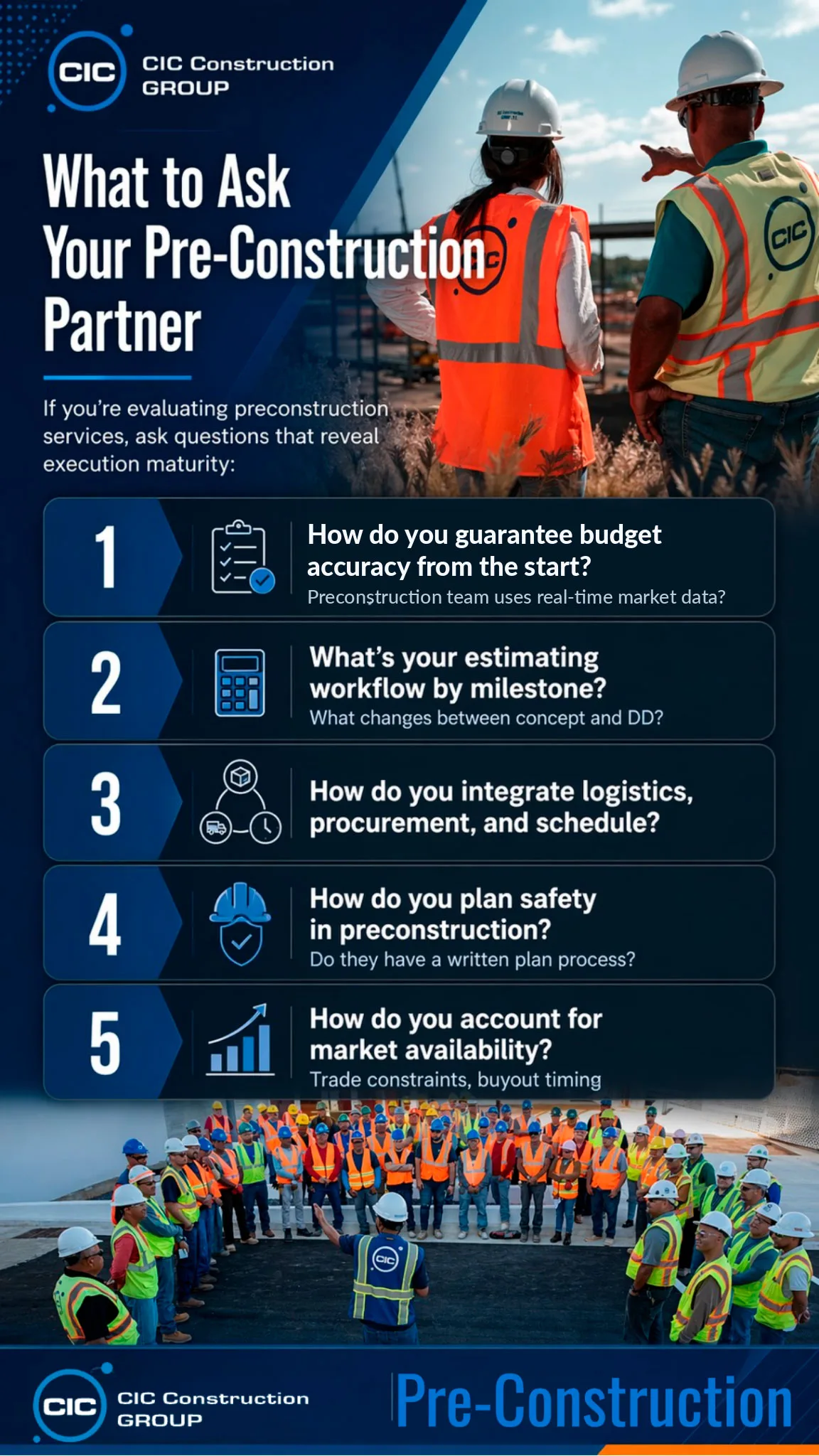
Ready to plan with confidence?
If you’re in the planning phase and want fewer surprises in construction, pre-construction is the phase where certainty is earned.
CIC’s preconstruction approach combines feasibility, constructability, budgeting discipline, scheduling, logistics, and early risk mitigation, so owners move into construction with a plan that’s buildable and defensible.
Let’s talk about your project goals, constraints, and what Pre-Construction can prevent before it becomes expensive.
FAQs (AEO-Friendly)
What are pre-construction services?
Pre-construction services include feasibility analysis, constructability review, milestone estimating, schedule development, logistics planning, trade market evaluation, and early risk mitigation before fieldwork begins.
How does preconstruction reduce final cost?
It reduces late discovery of constraints, prevents rework and change-driven redesign, improves procurement timing for long-lead items, and aligns scope and assumptions earlier, when changes cost less.
What is constructability review and why does it matter?
Constructability review tests whether design intent can be executed safely and efficiently, surfacing clashes, access constraints, sequencing issues, and scope gaps before construction starts.
What is PDRI and how does it reduce project risk?
PDRI is a scope-definition tool used in front-end planning to identify gaps and risk factors early, improving alignment and estimate confidence.
Why is safety planning part of preconstruction?
Preconstruction safety planning is strongly associated with improved safety outcomes and productivity, and it reduces schedule-disrupting incidents.
How do workforce constraints change scheduling in 2026?
When hiring difficulty is widespread, schedule assumptions must account for trade availability and procurement constraints earlier; early engagement and disciplined sequencing become critical.