How Modular Construction Solves 2026’s Biggest Industry Challenges
The construction industry faces 349,000 worker shortages in 2026, with 76% of projects finishing late and cost overruns affecting nearly half of all developments. Traditional construction methods, designed for a different labor market, timeline expectations, and quality requirements, are showing their limits in an environment demanding faster delivery, tighter budgets, and greater certainty.
Yet while these challenges intensify, a solution that was once considered niche has moved decisively into the mainstream. Modular and prefabricated construction is projected to grow to $207.82 billion by 2033.
According to the World Economic Forum Annual Meeting, growing trends within the construction industry point towards significant convergence with manufacturing through modular construction. This is operational reality delivering measurable results: projects completed 30-50% faster, labor requirements reduced by 40%, quality control improved through factory environments, and cost predictability that capital-intensive projects desperately need.
The question facing developers, facility owners, and project planners isn’t whether modular construction works, the data confirms it does. The question is how to implement it effectively for specific project types, and what distinguishes contractors who deliver successful modular projects from those treating it as simple prefabrication.
Why Modular Is Moving Mainstream Now
1) Labor scarcity makes efficiency non-negotiable
When the labor pool tightens, traditional site sequencing becomes fragile: a single missing trade can ripple into weeks of delay. That risk compounds on multi-phase programs where owners need dependable partners over years, not just for one job.
Modular changes the labor equation by moving significant work into controlled environments where:
- Productivity is less weather-dependent
- Workflows are repeatable
- Quality checks occur earlier and more consistently
Owners don’t adopt modular to “use fewer people.” They adopt it to reduce dependency on perfect field labor availability.
The construction workforce crisis isn’t temporary. Associated Builders and Contractors projects 350,000 additional workers needed in 2026 just to maintain current demand levels, with 92% of contractors reporting difficulty filling positions. As 41% of the current workforce retires by 2031, labor availability will become the primary constraint on construction capacity.
((Read Also: Half a Million Short: The Construction Workforce Crisis Reshaping Project Deliver))
2) Schedule compression becomes a competitive advantage
McKinsey research confirms volumetric modular construction can shorten project timelines by up to 50% by significantly decreasing on-site work requirements.
For commercial projects, this compression accelerates time-to-revenue, the most powerful ROI factor in development economics.
The schedule advantage extends beyond raw speed. Modular projects experience 80% fewer weather-related work stoppages because the majority of work occurs in controlled factory environments.
For owners, the value is not only earlier completion, it’s earlier certainty. A schedule you can trust improves:
- Financing planning,
- Operational startup sequencing,
- Tenant / commissioning timelines,
- Multi-phase capital forecasting.
3. Quality Control Demands Drive Factory Solutions
Construction quality has always involved managing variability: different crews, changing weather, inconsistent material deliveries, varying inspector interpretations. This variability creates costs… rework, delays, callbacks, warranty issues, that owners increasingly refuse to accept.
Factory-controlled modular construction addresses quality through manufacturing precision. All work occurs in controlled environments with consistent temperature, humidity, and lighting. The same crews build similar components repeatedly, developing muscle memory that catches errors before they compound. Material deliveries arrive in bulk, inspected before use. Quality checkpoints occur at each manufacturing station before components advance.
For owners of healthcare facilities, laboratories, cleanrooms, and other quality-critical environments, factory construction isn’t a cost-saving measure, it’s a quality assurance strategy that traditional methods cannot replicate.
How Modular Construction Works in Practice
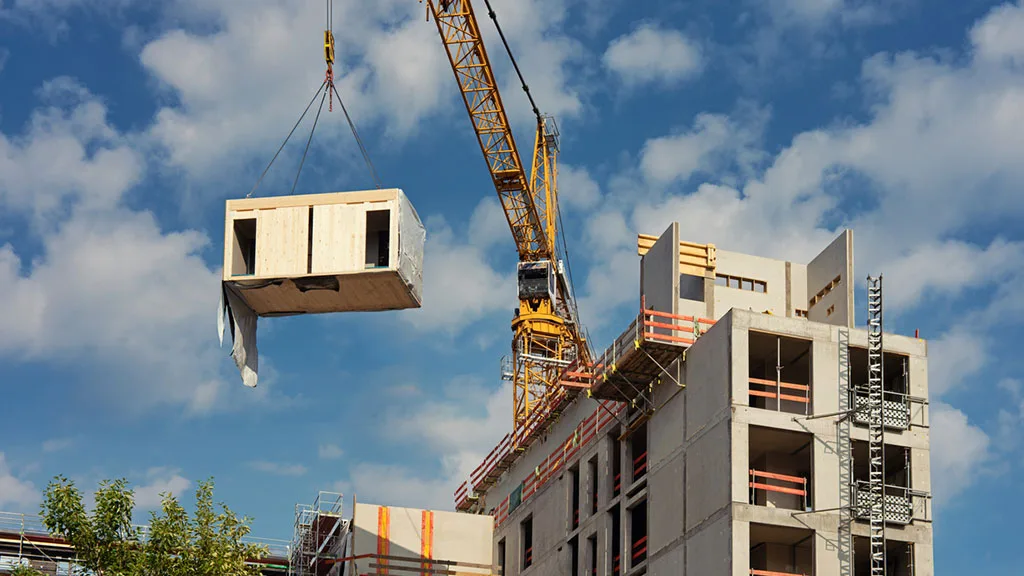
Understanding modular construction requires distinguishing it from simple prefabrication. While prefabrication involves manufacturing building components off-site, modular construction creates complete volumetric units-rooms or building sections that are 80-95% finished before leaving the factory.
The Modular Process
Design and Engineering
Projects begin with detailed design that accounts for modular dimensions, transportation constraints, crane capacities, and assembly sequences. This phase requires more precision than traditional construction because modules must fit together exactly—tolerances measured in millimeters rather than inches.
Building Information Modeling (BIM) becomes essential rather than optional. BIM adoption in modular construction improves design accuracy by 40% by enabling clash detection, coordination verification, and assembly simulation before any physical work begins.
Successful modular projects invest 10-15% more design time than traditional construction, but this investment prevents issues that would consume far greater time and cost during construction.
Factory Manufacturing (Concurrent with Site Preparation)
While site teams excavate, pour foundations, and install underground utilities, factory teams manufacture building modules. This parallel execution is where modular construction compresses schedules most dramatically.
Modules are constructed on assembly lines with specialized workstations for framing, mechanical/electrical/plumbing (MEP) installation, insulation, drywall, finish work, and final inspection. Prefabricated MEP systems save 15% on installation time compared to field coordination because routing is planned and executed without interference from other trades.
Quality control occurs at each station. Inspectors verify work before modules advance, preventing compounding errors. Completed modules undergo final inspection before transport, ensuring only specification-compliant units leave the factory.
Transportation and Assembly (Final Month)
Finished modules transport to project sites on specialized carriers. Requiring route planning, permits, and escort vehicles for oversized loads.
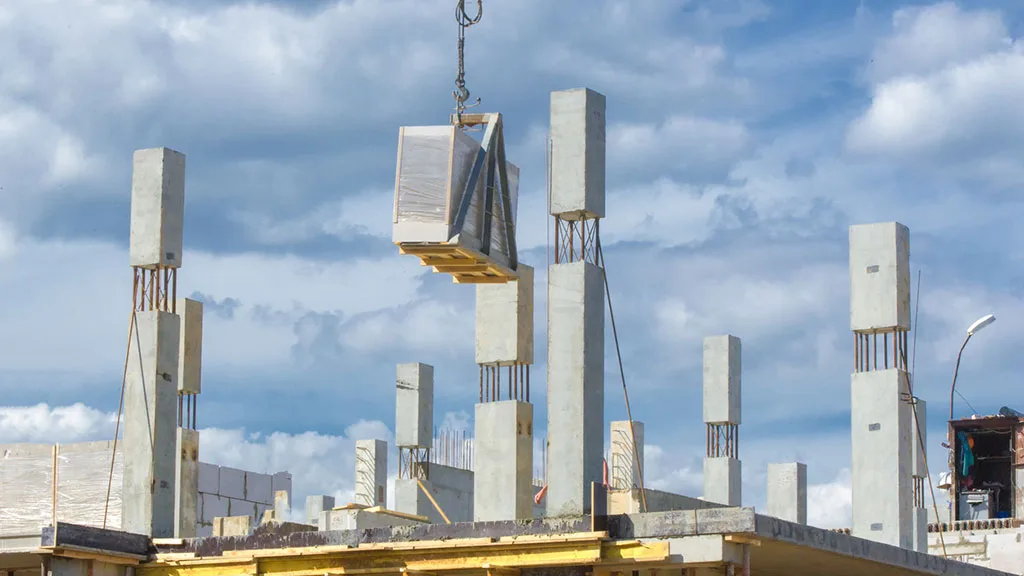
On-site assembly happens quickly. Cranes set modules onto prepared foundations, crews bolt connections, seal joints, and complete finish work where modules meet.
MEP systems connect at pre-designed junction points. Final inspections verify assembly quality and system functionality.
Where Modular Construction Delivers Maximum Value
Not every project benefits equally from modular construction. The method delivers greatest advantages when projects involve:
Repetitive Design Elements
Buildings with many similar rooms like hotels, student housing, multifamily residential, patient towers, barracks, achieve maximum efficiency through modular construction. Once the factory establishes production for one unit, subsequent units benefit from refined processes and crew familiarity.
The hospitality sector has embraced this aggressively. Marriott International has built multiple modular hotels, demonstrating the method’s viability for brands requiring consistent room quality across properties
Schedule-Driven Projects
Any project where early completion generates financial value or avoids operational disruption benefits from modular’s compressed timelines. Healthcare expansions that can’t shut down existing operations, hotels opening for peak seasons, student housing ready for fall semester, manufacturing facilities minimizing production interruptions.
For developers, reduced construction timelines mean earlier occupancy and rent income, the most powerful ROI factor.
Quality-Critical Environments
Cleanrooms, laboratories, healthcare facilities, and food processing plants require precision installation and contamination control difficult to achieve on traditional construction sites. Factory environments provide the control these applications demand.
Pharmaceutical and biotechnology facilities particularly benefit. Modular cleanrooms are manufactured to ISO 14644 standards in controlled factory conditions, then sealed and transported complete. This eliminates the contamination risks inherent in field-built cleanrooms where dust, humidity, and worker traffic create ongoing control challenges.
Labor-Constrained Locations
Remote sites with limited skilled labor availability, urban locations with restrictive site access, or regions experiencing severe labor shortages gain advantage from modular construction’s reduced on-site workforce requirements.
Why Successful Modular Projects Require Expert Execution?
Modular construction’s advantages are real, but they don’t happen automatically. Successful modular projects require systematic integration across design, manufacturing, logistics, and assembly phases:
- Design Coordination Must Be Precise
- Factory Quality Doesn’t Guarantee Project Quality
- Logistics Complexity Increases
CIC’s Hybrid Approach: Combining Traditional and Modular Methods
At CIC Construction Group, our approach to modular construction differs from firms treating it as complete replacement for traditional methods. We view modular as another tool in construction delivery, powerful when applied to appropriate applications, combined strategically with conventional methods for optimal results.
Our hybrid methodology evaluates each project element individually:
- Modular applications: Building elements with repetitive design, critical quality requirements, or schedule sensitivity move to factory manufacturing. Patient rooms, hotel guestrooms, residential units, laboratory modules, mechanical rooms.
- Traditional construction: Unique architectural features, site-specific elements, structural systems requiring field placement, and components where conventional methods prove more efficient remain traditionally built. Complex building cores, custom facades, large-span structural systems, site improvements.
This selective approach maximizes modular’s advantages while avoiding the compromises that occur when forcing entire projects into modular execution regardless of suitability.
Our teams work with modular manufacturers during design development. This early collaboration identifies transportation constraints, manufacturing limitations, and assembly requirements while design changes remain inexpensive rather than discovering conflicts during production.
Quality Assurance Across Phases
Our quality approach spans factory and field. We maintain inspection presence during module manufacturing, verifying compliance before transport rather than discovering issues during assembly. This investment in factory oversight prevents the expensive problems that occur when defective modules arrive on-site.
On-site assembly receives the same rigorous oversight we apply to traditional construction. Module setting, connection bolting, joint sealing, and MEP integration undergo inspection at each phase. We treat the integration points between modules as critical connections requiring precision installation and verification.
Moving Forward
The construction industry’s workforce crisis, schedule challenges, and quality demands represent permanent changes requiring new delivery methods. Modular construction has moved from experimental alternative to proven solution deployed across healthcare, hospitality, education, residential, and industrial sectors.
But successful modular execution requires more than enthusiasm for innovation. It demands rigorous planning, precise coordination, systematic quality control, and contractors experienced in integrating factory manufacturing with field construction.
When these elements align, modular construction delivers the results owners need: faster completion, predictable costs, consistent quality, and execution certainty that traditional methods struggle to match in 2026’s construction environment.
At CIC Construction Group, we combine 42 years of construction experience with strategic modular integration for projects requiring speed, quality, and certainty. Our hybrid approach applies modular methods where they deliver maximum advantage while using traditional construction for elements best built conventionally.
If you’re planning a project where schedule compression, quality control, or labor efficiency are critical, connect with our team to discuss how our systematic approach to modular construction can benefit your development.