Decided Before the Dig: The Pre-Construction Choices That Quietly Determine Project Outcomes
Pre-construction is where the most important project decisions are made. Scope, budget, schedule, procurement, constructability, and risk are shaped before construction begins.
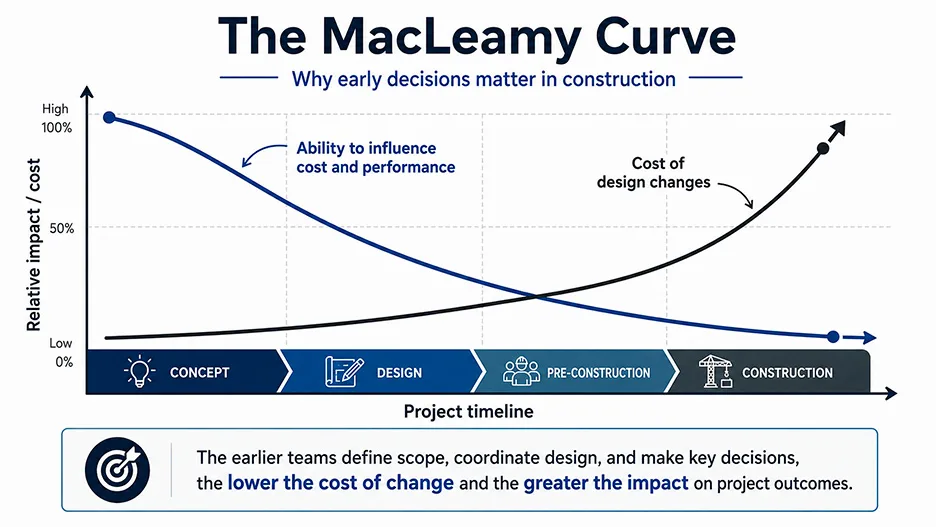
The evidence is clear: the ability to influence cost and function is highest early, while the cost of change rises as a project moves toward construction. That is the core lesson of the MacLeamy Curve.
For owners, the takeaway is simple: pre-construction is not paperwork before the real work. It is the phase where uncertainty becomes a buildable plan.
Why do the most important project decisions happen before construction starts?
Because early decisions set the limits every later decision must live within.
By the time construction begins, much of the project’s cost, schedule, risk, and quality profile has already been shaped. The jobsite is where the project becomes visible. It is not where the project is truly decided.
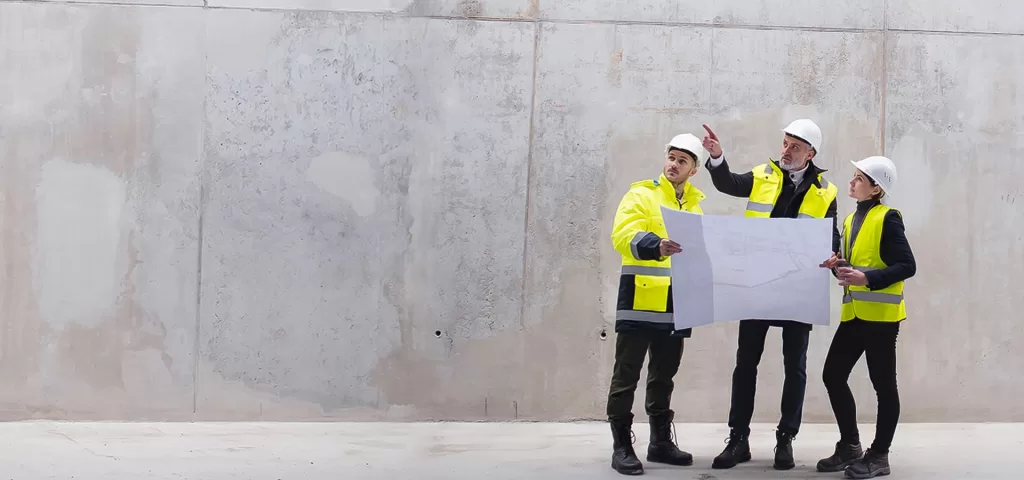
Before excavation, teams should already know what is being built, why it is being built, how complete the scope is, whether the design can be built as drawn, what the budget can realistically support, which systems may affect procurement, and how the work should be phased.
A strong construction phase can execute a good plan. It cannot fully rescue a weak one.
That is why experienced owners treat pre-construction as a high-leverage phase. It is the window where teams can still correct assumptions, coordinate scope, validate costs, identify schedule risks, and make changes before they become expensive field problems.
FAQ: What is pre-construction in a building project?
Pre-construction is the planning and design phase before physical construction. It includes scope definition, constructability review, design coordination, budget validation, schedule and phasing strategy, risk identification, and long-lead procurement planning. Its purpose is to make the project defined enough that construction can proceed with fewer changes, delays, and surprises.
What does the MacLeamy Curve say about project decisions?
The MacLeamy Curve explains a simple construction truth: early decisions have the greatest ability to shape cost and function, while late changes cost more and influence less.
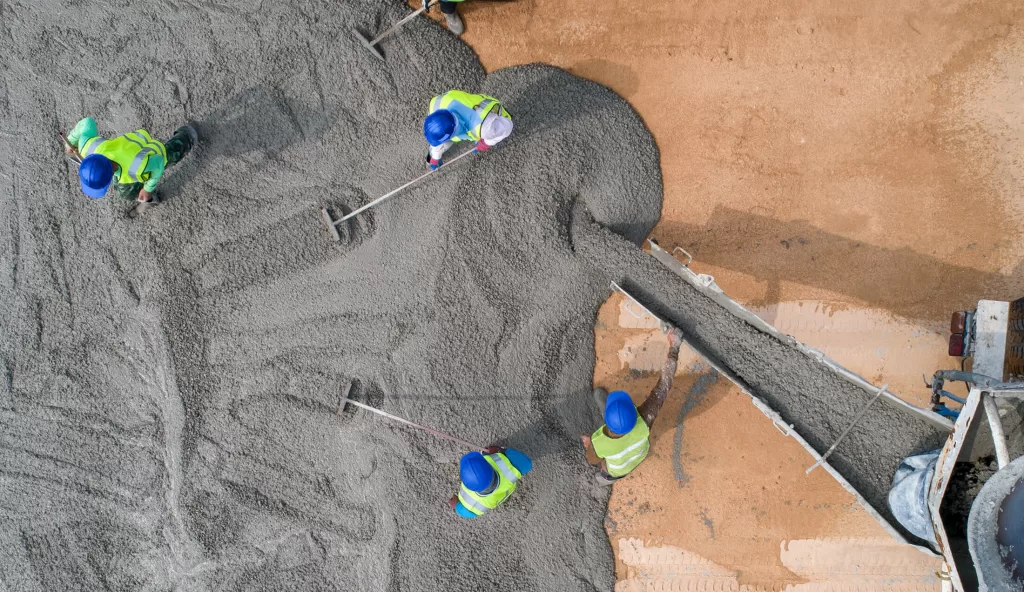
Changing a layout during design may require a meeting and a revised drawing. Changing the same condition after a slab is poured can require demolition, replacement, schedule recovery, and new coordination across trades.
The decision may be the same. The cost changes because the timing changes.
That is the practical value of pre-construction. It moves problem-solving into the phase where drawings, systems, budgets, and sequences are still flexible. The goal is not to plan for the sake of planning. The goal is to make the same hard decisions while they are still affordable to act on.
FAQ: What is the MacLeamy Curve?
The MacLeamy Curve is a diagram introduced by architect Patrick MacLeamy in 2004. It shows that a project team’s ability to influence cost and function is highest early, while the cost of making design changes rises as the project advances. It supports front-loading decisions during planning and design.
How often do projects miss budget and schedule?
More often than owners expect.
Research associated with Bent Flyvbjerg’s work at Oxford, compiled by BudgetOverrun.com, found that only about 8.5% of projects finish on both budget and schedule. The same body of work has become widely cited because it shows that cost and schedule failure are not rare events. They are recurring project risks.
For large and complex projects, the pattern is even more important. Delay is not only lost time. It can multiply cost. A project that extends by months may carry additional general conditions, escalation, labor impacts, procurement disruptions, financing costs, and opportunity costs.
Pre-construction matters because many of the conditions that create overruns are visible before construction begins. Poorly defined scope, incomplete coordination, unrealistic budgets, unclear phasing, and unidentified procurement risks usually do not appear out of nowhere. They are often carried into the field from decisions that were not resolved early.
FAQ: What percentage of construction projects go over budget?
It varies by project type and methodology, but the record is poor across sectors. Oxford-linked research covering more than 16,000 projects found that only about 8.5% finish on both budget and schedule. The consistent lesson is that on-budget, on-schedule delivery is the exception, not the default.
What causes change orders and rework?
A major source is incomplete or uncoordinated design.
Change orders can come from owner changes, unforeseen conditions, code requirements, material substitutions, and market conditions. But design errors and omissions are especially costly because they often surface during construction, when correction is more disruptive.
Rhumbix identifies design issues as a leading cause of change orders, citing design changes as a major contributor to cost overruns and delays. Wightman also explains that errors and omissions in design documents are a regular source of change orders, with industry references placing average change orders due to architectural and engineering errors and omissions in the 3% to 5% range of construction budget.
For owners, the important distinction is simple.
An omission is work that was left out but still needed. The owner likely would have paid for it if it had been documented earlier.
An error is more damaging. It may require correcting or replacing work already built. That means paying for the original work, paying for demolition or rework, and paying again to build it correctly.
The best defense is not better dispute management after the fact. It is better coordination before construction starts.
FAQ: What is the most common cause of construction change orders?
One of the most common causes is errors and omissions in design documents. When drawings or specifications contain gaps, conflicts, or mistakes, the issue often becomes visible during construction. At that point, correction may require added cost, added time, rework, or formal change orders.
What is front-end planning, and why does it work?
Front-end planning is the structured process of defining a project before major resources are committed.
The Project Management Institute describes preproject planning as the process of developing enough strategic information for owners to address risk and decide whether to commit resources. That definition matters because it frames planning as a risk-management function, not an administrative step.
The Construction Industry Institute developed the Project Definition Rating Index, known as PDRI, to make scope definition measurable. PDRI is a structured checklist that helps teams evaluate how completely a project has been defined before detailed design or construction.
The reason this works is direct: poorly defined projects carry hidden assumptions. Those assumptions become questions, RFIs, substitutions, change orders, delays, or rework once construction begins.
A well-defined project is not luckier. It is clearer.
FAQ: What is the Project Definition Rating Index, or PDRI?
PDRI is a front-end planning tool developed by the Construction Industry Institute. It uses a weighted checklist to evaluate how completely a project’s scope is defined before detailed design or construction. A lower score indicates stronger definition. A higher score flags areas that still need resolution before moving forward.
Why does early contractor involvement change the outcome?
Because it brings construction reality into the design phase.
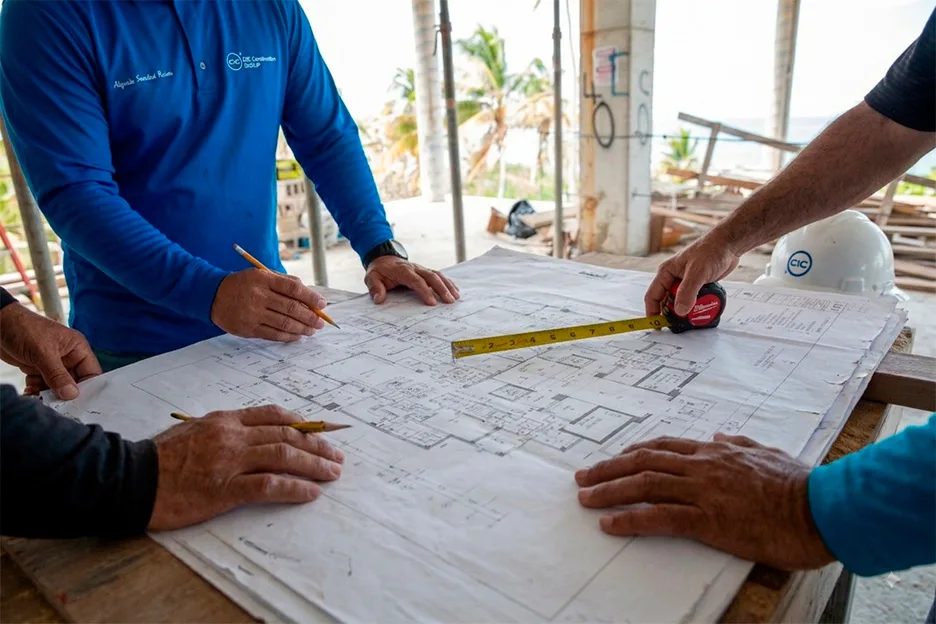
Early contractor involvement, often called ECI, means the builder participates before the documents are complete. That allows the team to test constructability, budget, sequencing, procurement, phasing, logistics, and trade coordination while the design can still be adjusted.
Without that input, practical issues often surface later. A detail may not be buildable as drawn. A system may exceed the budget. A sequence may not match site conditions. A material or piece of equipment may have a lead time that does not fit the schedule.
Caught during design, these issues are conversations. Caught during construction, they become change orders, schedule pressure, or claims.
Collaborative delivery methods such as design-build and construction manager at risk are built around this principle. They bring construction insight forward so the project team can solve problems incrementally rather than discovering them all at once after design is complete.
FAQ: What is early contractor involvement?
Early contractor involvement is the practice of engaging the contractor during design, rather than after design is complete. It allows constructability, cost, schedule, sequencing, and procurement insight to shape the project while changes are still easier and less expensive to make.
How does long-lead procurement protect the schedule?
It identifies the items that can control the project schedule before they become delays.
On many projects, the critical path does not run only through field work. It runs through waiting for a system, material, or piece of equipment to arrive.
Long-lead items can include specialized mechanical and electrical equipment, custom fabrications, switchgear, major building systems, specialty doors, façade components, or any material whose delivery timeline can affect the construction sequence.
If these items are identified during pre-construction, procurement can begin early enough to protect the schedule. If they are identified after construction is underway, the project absorbs the full lead time as delay.
That is why procurement planning belongs in pre-construction. It is not just purchasing. It is schedule protection.
FAQ: What are long-lead items in construction?
Long-lead items are materials, equipment, or systems with delivery times long enough to affect the project schedule. Examples may include specialized mechanical and electrical equipment, custom fabrications, and certain building systems. Identifying them during pre-construction allows procurement to start before they delay the field.
What should owners expect from a rigorous pre-construction process?
Owners should expect visible decisions, not general reassurance.
A rigorous pre-construction process should produce a defined scope, a coordinated and constructable design, a validated budget, a realistic schedule, a risk register, and a procurement plan before construction begins.
Owners can test the strength of the process by asking direct questions:
- Is the scope defined well enough to price and build without major assumptions?
- Has the design been reviewed by people who understand how it will actually be built?
- Has the budget been validated against current market conditions?
- Have long-lead items been identified?
- Has the team named the project’s real risks?
- Is there a clear phasing and logistics strategy?
- Are open assumptions documented and owned?
A strong pre-construction partner can answer with process, evidence, and traceable decisions. A weak process answers with optimism.
That difference matters because optimism does not coordinate drawings, validate budgets, or protect the schedule.
FAQ: How can an owner tell if a pre-construction process is thorough?
Look for structured outputs: a defined scope, constructability review, budget validation, schedule and phasing strategy, risk register, and long-lead procurement plan. A thorough process makes decisions visible and traceable. A weak one leaves assumptions unresolved until construction begins.
What is the difference between pre-construction and estimating?
Estimating is one part of pre-construction. It is not the whole discipline.
An estimate produces a cost figure. Pre-construction determines whether that number is realistic enough to rely on.
That requires scope definition, constructability review, design coordination, market validation, schedule development, procurement planning, logistics review, risk identification, and phasing strategy.
A reliable estimate depends on those inputs. Without them, a cost number may look precise while still being built on weak assumptions.
For owners, this distinction is important. Choosing a partner for pre-construction is not only about who can price drawings. It is about who can help make the project clearer, more buildable, and more predictable before the field work starts.
FAQ: Is pre-construction worth the added time before breaking ground?
For complex projects, yes. The time invested in defining scope, coordinating design, validating budget, and planning procurement is small compared with the cost of change orders, rework, and delays that can appear during construction when hard questions are deferred.
How CIC Construction Group approaches pre-construction
CIC Construction Group treats pre-construction as an engineering discipline that produces certainty, not as paperwork before construction begins.
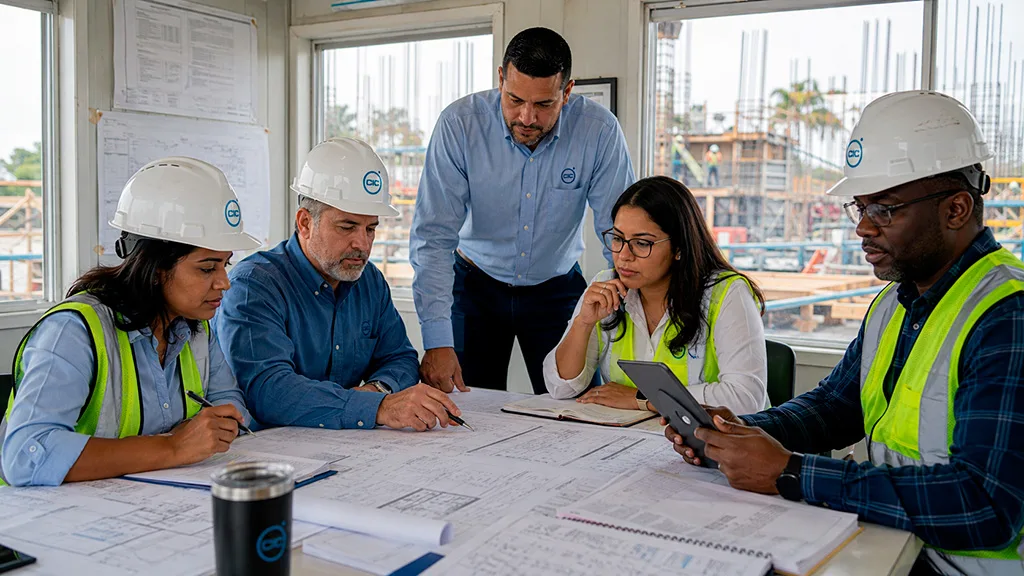
The work of the phase is to define the project, pressure-test the design for constructability, validate the budget against market conditions, identify long-lead items, name risks early, and build a schedule and phasing strategy that reflects how the project will actually be executed.
That discipline reflects CIC’s experience delivering complex projects across life sciences, healthcare, industrial, commercial, and institutional sectors in Puerto Rico, North Carolina, and Florida.
In those environments, late discovery is expensive. Schedule slippage carries real consequences. Coordination gaps between design intent and field execution cannot be left for the jobsite to solve.
CIC’s value is bringing construction insight into the conversation while the documents are still taking shape. That is when tradeoffs can be evaluated clearly, risks can be addressed directly, and decisions can still be made on paper instead of in the field.
For owners, the question is not only who can build once the drawings are complete. The better question is who should be at the table while those drawings are still being shaped.
The decisions made before the dig quietly determine the outcome. A strong pre-construction partner helps make those decisions deliberately, before they become expensive to change.
About CIC Construction Group: CIC Construction Group has delivered complex construction projects since 1983, with offices in Puerto Rico, North Carolina, and Florida. Our integrated services include Pre-Construction, General Contracting, Design-Build, Structural Steel, Concrete, Architectural Interiors, and Construction Equipment. Learn more at cicconstruction.com.