Beyond Traditional Office Space, Innovative Commercial Construction for Modern Business Needs
The commercial construction landscape is undergoing its most significant transformation in decades. As businesses reimagine how people work, shop, and interact, the physical spaces that house these activities must evolve accordingly. Today’s commercial projects demand far more than four walls and a roof—they require intelligent integration of technology, flexibility to adapt to changing needs, and designs that prioritize human experience alongside operational efficiency.
The numbers tell a compelling story. Global construction spending is projected to reach $15.7 trillion in 2025, representing 8.1% growth year-over-year. Yet within this expansion, the commercial sector faces a crucial inflection point: construction spending for nonresidential buildings is expected to grow just 2.2% in 2025, following years of double-digit increases. This moderation signals a market shift from quantity to quality—from simply building more space to creating smarter, more purposeful environments.
For commercial developers, corporate real estate teams, and business owners planning new facilities, understanding these evolving dynamics it’s essential for competitive advantage.
The New Reality of Workplace Design: Flexibility as Foundation
The traditional office model, rows of assigned desks in static configurations, has given way to something far more dynamic. Accorgin to CBRE, The percentage of companies opting for assigned seating has declined from 83% to 55%, while hybrid and desk-sharing models have surged from 12% to 36%. This isn’t just a trend; it’s a fundamental recalibration of how we approach commercial space.
The flexible workspace sector demonstrates the demand for adaptability. The U.S. experienced a 13% year-over-year increase in coworking inventory by square footage through Q3 2024, with the total number of spaces growing 22% over the same period. Even more telling: suburban markets saw coworking inventory grow 36% year-over-year in New Jersey alone, as hybrid workers prioritize locations closer to home, Cushman & Wakefield says, citing data from Coworking Cafe.
What Drives Employee Workplace Preferences
In the 2026 Salary Guide From Robert Falf, research shows higher compensation can influence many job candidates to work on-site full time: 66% of professionals say they would be willing to come into the office 5 days a week for a higher salary. If increasing pay isn’t an option, providing remote flexibility can be a big draw for top talent. For developers and corporate real estate teams, this means designing spaces that offer choice—not just in when people work, but how and where within the facility.
Modern commercial construction must accommodate:
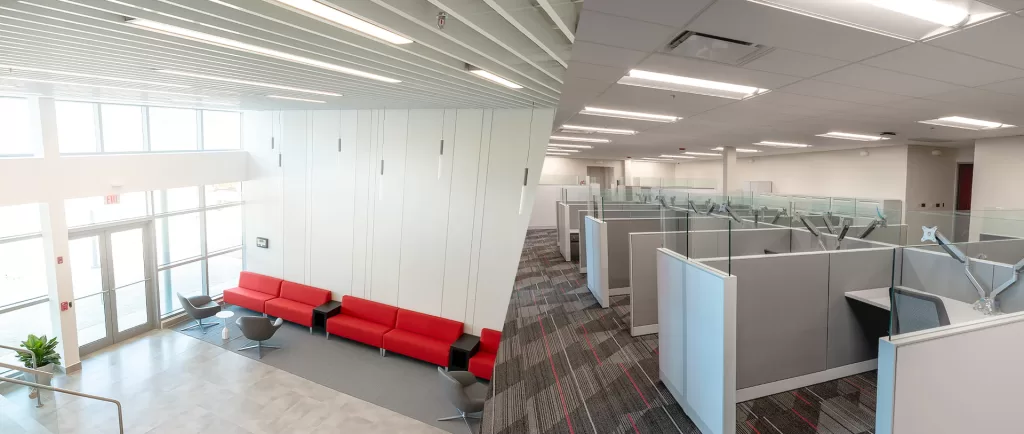
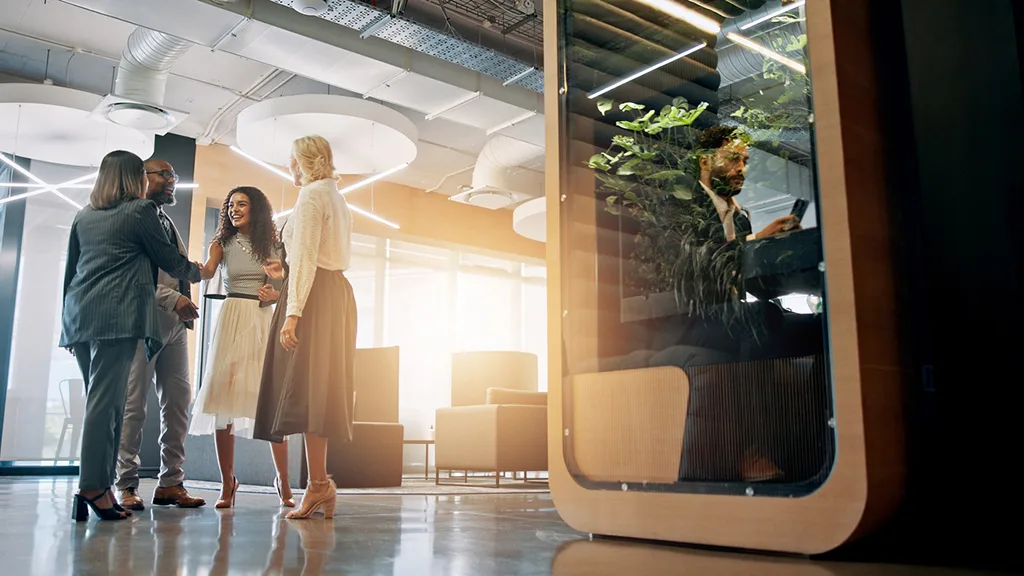
- Multiple work modes: Collaborative zones, focused work areas, social spaces, and private meeting rooms
- Technology-enabled flexibility: Hot-desking systems, smart booking platforms, and seamless connectivity throughout
- Adaptable layouts: Modular furniture and movable walls that allow spaces to evolve with organizational needs
- Wellness-centered amenities: Natural light, biophilic design elements, and spaces that support mental and physical health
Space Utilization: The Critical Metric
Understanding how space actually performs has become paramount. Space utilization ranked as the most important metric for workplace leaders surveyed by CBRE, with 46% relying on utilization data to plan their hybrid programs.
North America showed significant improvement with 36% utilization, up 9.5 points from the previous year and 11 points versus the last two quarters, driven by stricter RTO mandates, enhanced workplace environments, and increasing recognition of the value of in-office time. significant optimization opportunities, according to de Workplace Utilization Index Q2-Q4 2025 DATA.
The data reflect: an increasing number of companies are implementing stricter return-to-office mandates, especially in tech and finance. Proactive organizational efforts to create more inviting and productive work environments, like moving to more premium spaces and proactively enhancing work environments using data-driven insights.
Smart Building Technology, The Invisible Infrastructure of Modern Commerce
The integration of intelligent building systems has moved from competitive advantage to baseline expectation. The global smart building market was valued at $103 billion in 2024 and is projected to grow at a 24.4% CAGR to reach $827.7 billion by 2034, driven by demands for energy efficiency, operational excellence, and enhanced occupant experiences.
Core Technologies Transforming Commercial Spaces
AI-Powered Building Management
Advanced HVAC systems now use AI to optimize climate control, adapting to occupancy patterns and external weather conditions in real-time. These systems maintain comfort, predict needs, prevent failures through predictive maintenance, and continuously optimize energy consumption.
IoT Integration and Data Analytics
The proliferation of IoT sensors throughout commercial buildings creates a continuous feedback loop. From monitoring desk occupancy to tracking meeting room utilization and measuring air quality, these systems generate actionable insights that inform both immediate operational decisions and long-term strategic planning.
Cloud-Based Management Platforms
The shift from on-premises systems to cloud-managed solutions enables enhanced scalability, flexibility, and remote management capabilities—critical for organizations managing multiple properties across diverse geographies.
The ROI of Smart Building Integration
The financial case for smart building technology is compelling. Smart buildings can reduce energy use by up to 30%, directly impacting operational costs while supporting sustainability goals. For commercial developers and corporate real estate teams, these systems provide:
- Reduced operational expenses: Through optimized energy management and predictive maintenance
- Enhanced tenant satisfaction: Via improved comfort, air quality, and seamless technology experiences
- Future-proof infrastructure: That can adapt as technology and business needs evolve
- Data-driven decision making: For space planning, utilization optimization, and investment prioritization
CIC Construction Group’s Approach: Throughout our portfolio—including the Ritz Carlton Reserve, Nordstrom flagship locations, and the Fairmont San Juan Hotel—we’ve pioneered the integration of smart building systems that balance technological sophistication with operational simplicity. Our projects demonstrate that intelligent buildings aren’t just about having the latest technology; they’re about deploying systems that genuinely enhance how spaces perform for their intended purposes.
Experiential Retail: Where Commerce Meets Community
The retail apocalypse narrative has given way to a retail renaissance—but one with dramatically different parameters. Physical retail is thriving, but only when it offers something e-commerce cannot: memorable, engaging, human experiences.
Data from Bazaarvoice survey shows that 80% of shoppers use a mix of online and in-store shopping, with only 13% exclusively online and 7% solely in-store. The future isn’t digital or physical—it’s seamlessly integrated, with physical spaces playing a crucial experiential role.
Design Elements That Drive Engagement
Successful experiential retail construction incorporates:
- Interactive displays and technology: VR experiences, smart mirrors, and augmented reality try-on capabilities
- Multi-sensory environments: Carefully curated acoustics, lighting, scents, and textures that create emotional connections
- Instagrammable moments: Spaces designed for social sharing that extend brand reach organically
- Flexible event spaces: Areas that can transform from product displays to venues for workshops, performances, or community gatherings
Mixed-Use Developments: Creating Integrated Communities
Perhaps no trend better exemplifies the evolution of commercial construction than the rise of sophisticated mixed-use developments. These projects aren’t simply buildings with different uses stacked on top of each other—they’re carefully orchestrated ecosystems that create value through integration and synergy.
Beyond the Office-Retail-Residential Template
Modern mixed-use projects are far more sophisticated than first-generation developments. The mixed-use model has evolved beyond the standard office-retail-residential template. Today’s developments incorporate:
- Advanced manufacturing and life sciences facilities alongside traditional office space
- Health and wellness amenities including fitness centers, medical services, and wellness programming
- Entertainment venues from performance spaces to experiential attractions
- Hospitality components that serve both residents and visitors
- Green infrastructure including parks, urban agriculture, and sustainability features

The Value Proposition for Developers
Mixed-use developments offer several strategic advantages:
Risk Diversification: Multiple revenue streams reduce exposure to sector-specific downturns.
Enhanced Value Creation: The synergies between uses create value that exceeds what each component would generate independently.
Sustainability Alignment: Mixed-use developments reduce the need for car travel and encourage walkability, supporting both environmental goals and quality-of-life improvements.
Critical Success Factors
Not all mixed-use projects succeed. The winners share common characteristics:
- Careful tenant curation that creates complementary rather than competing uses
- Exceptional connectivity both physical (walkability, transit access) and digital
- Thoughtful programming with events and activations that bring people together
- High-quality public spaces that serve as community gathering points
- Flexible infrastructure that can adapt as market conditions and tenant needs evolve
CIC’s Mixed-Use Expertise: Our work on properties like the Fairmont San Juan Hotel showcases how to integrate hospitality, retail, and entertainment functions into cohesive environments that serve both guests and the broader community. The project demonstrates that successful mixed-use development requires not just construction expertise, but deep understanding of how different functions interact and enhance each other.
The Space Optimization Imperative
Understanding True Utilization. The challenge isn’t just measuring occupancy—it’s understanding effectiveness. Organizations are increasingly prioritizing workplace experience as a crucial factor in real estate success, with effectiveness now more important than efficiency as a success indicator.
Current utilization patterns reveal opportunities for dramatic improvements:
- Enclosed meeting room utilization (58%) is more than double the utilization of open areas (23%), suggesting need for more private spaces
- Utilization of private focus areas runs 21% higher than for open workstations, reflecting growing need for quiet zones
- North American workplaces continue to show the lowest regional utilization at just 26.5% average, indicating substantial optimization potential
Strategies for Optimization
Forward-thinking organizations are deploying several approaches:
Activity-Based Working: Designing spaces around activities rather than individual ownership, with diverse zones for different work modes.
Technology-Enabled Flexibility: Smart booking systems, occupancy sensors, and analytics platforms that provide real-time visibility into space usage.
Design for Multiple Generations: Creating inclusive environments that serve diverse work styles and preferences across generational cohorts.
Future-Ready Construction: Building for What’s Next
The most sophisticated commercial construction projects today are designed with adaptation in mind. As McKinsey research shows that over 90% of organizations will be combining remote and on-site work, the imperative is clear: build for flexibility, not just for current needs.
Key Trends Shaping the Next Generation
Sustainability as Standard
The European green building market is expected to reach $198 billion in 2025 and $334 billion by 2030, representing an 11% CAGR as energy efficiency and carbon reduction directives tighten. Sustainability it’s an increasingly regulated requirement and tenant expectation.
Wellness-Centered Design
Post-pandemic awareness has elevated health considerations. Modern commercial construction integrates:
- Advanced air filtration and purification systems
- Biophilic design elements connecting occupants with nature
- Ergonomic infrastructure supporting physical health
- Spaces that facilitate both collaboration and mental respite
Hybrid-Ready Infrastructure
With hybrid work models firmly established, new construction must support seamless integration of remote and in-person participation through advanced AV systems, designed collaboration spaces, and technology infrastructure that enables rather than constrains.
Data-Driven Adaptability
Buildings that can collect, analyze, and act on usage data will continuously optimize themselves, becoming more valuable and effective over time rather than gradually obsolescing.
The Path Forward: Strategic Considerations for Your Next Commercial Project
As you plan your next commercial development, several questions merit careful consideration:
How will this space need to adapt over its lifecycle? Buildings designed with flexibility built-in maintain value and relevance far longer than those optimized for a single moment in time.
What technology infrastructure will enable both current and future needs? The pace of technological change demands infrastructure that can accommodate evolution without requiring complete reconstruction.
How will this project integrate with its broader context? Whether urban or suburban, the most successful commercial projects create value through thoughtful integration with their surroundings—physical, social, and economic.
What experience will this space create for its occupants? In an era where experience differentiates, the physical environment isn’t just shelter—it’s a tool for engagement, productivity, and brand expression.
Conclusion: Building the Future of Commercial Space
The commercial construction industry stands at an inflection point. The projects being conceived and built today will shape how we work, shop, and interact for decades to come.
The winners in this new era won’t simply be those who build bigger or faster—they’ll be those who build smarter, with deeper understanding of how space serves human needs, how technology enables rather than complicates, and how buildings can adapt and remain relevant across changing conditions.
At CIC Construction Group, we’re committed to being your partner. Our decades of experience, combined with continuous innovation and unwavering commitment to excellence, position us to help you create commercial spaces that anticipate tomorrow’s opportunities.
Ready to discuss your next commercial construction project? Contact CIC Construction Group to explore how our experience with premium hospitality, retail, and mixed-use developments can help bring your vision to life.